
What Actually Makes Swimwear Photography Better
Short answer: Better swimwear photography comes from planning the shoot in advance, understanding how light behaves in different environments, and working with the right people on set — not from buying newer camera gear.
If you're looking for a list of camera settings that'll magically make your swimwear photography better, this probably isn't the article for you.
I've been shooting swimwear for years, both in the studio and on location, and honestly, the biggest improvements in my work didn't come from buying another lens or upgrading my camera body. They came from understanding light, planning shoots better, working with great people, and simply getting out there and shooting.
I've photographed swimwear for brands, portfolio sessions, annual Summer Sessions, and countless test shoots. Some of my favorite work came from beach shoots for Makai, a swimwear shoot in the middle of the desert, and a pool shoot where the lighting was about as opposite of what most photography blogs would recommend.
This isn't the only way to shoot swimwear photography. It's just what's consistently worked for me.
Table of Contents
Plan the Shoot Before You Pick Up the Camera
Learn Light Before You Buy More Gear
My Favorite Lighting Setups
Styling Matters More Than People Think
Skin Prep and Product Tricks I Always Use
The Gear I Actually Bring
Don't Be Afraid to Shoot Bad Photos
If You Want to Get Into Swimwear Photography
FAQ: Swimwear Photography
Final Thoughts
Plan the Shoot Before You Pick Up the Camera
One thing I've learned over the years is that the camera is probably one of the least important parts of a great swimwear shoot.
The best images usually start weeks before anyone steps in front of the lens.
Think about:
The location
Wardrobe
Props
Hair and makeup
The overall vibe you're trying to create
One of my favorite shoots was with Toni in the desert. I'd wanted to shoot something like that for a long time. We finally planned it out, found the right location with red rock formations everywhere, styled everything around a desert picnic concept, brought props, and executed it.
It worked because we didn't just show up hoping inspiration would happen.
We built the shoot before we ever took the first photo.
Every time I've put more effort into planning, the images have reflected it.
Learn Light Before You Buy More Gear
If there's one thing I'd tell photographers to spend time learning, it's light.
Not gear.
Light.
You can have the newest camera, the sharpest lens, and every accessory imaginable, but if you don't understand how light behaves, none of it really matters.
I always tell people it's like having the best hammer in the world but forgetting all your nails.
Over the years I've realized that understanding shadows, highlights, reflections, and how different environments change light has done more for my photography than any camera purchase ever has.
When you understand light, you stop chasing gear.
My Favorite Lighting Setups
There isn't one "correct" way to shoot swimwear.
Different environments call for different approaches.
Studio
When I'm shooting swimwear in the studio, I actually prefer direct flash.
A lot of photographers try to soften everything, but I like the harder, punchier look. It reminds me of sunlight without actually being outside.
It gives swimwear images a clean commercial feel that I've always gravitated toward.
It's just a look I personally love.
Beach
At the beach, I usually prefer shooting a little before sunset through sunset.
That window gives me a mix of softer light while still keeping enough direction and contrast to make the swimwear pop.
It's forgiving, flattering, and still has energy.
Pool
Here's where I'll probably disagree with a lot of photography articles.
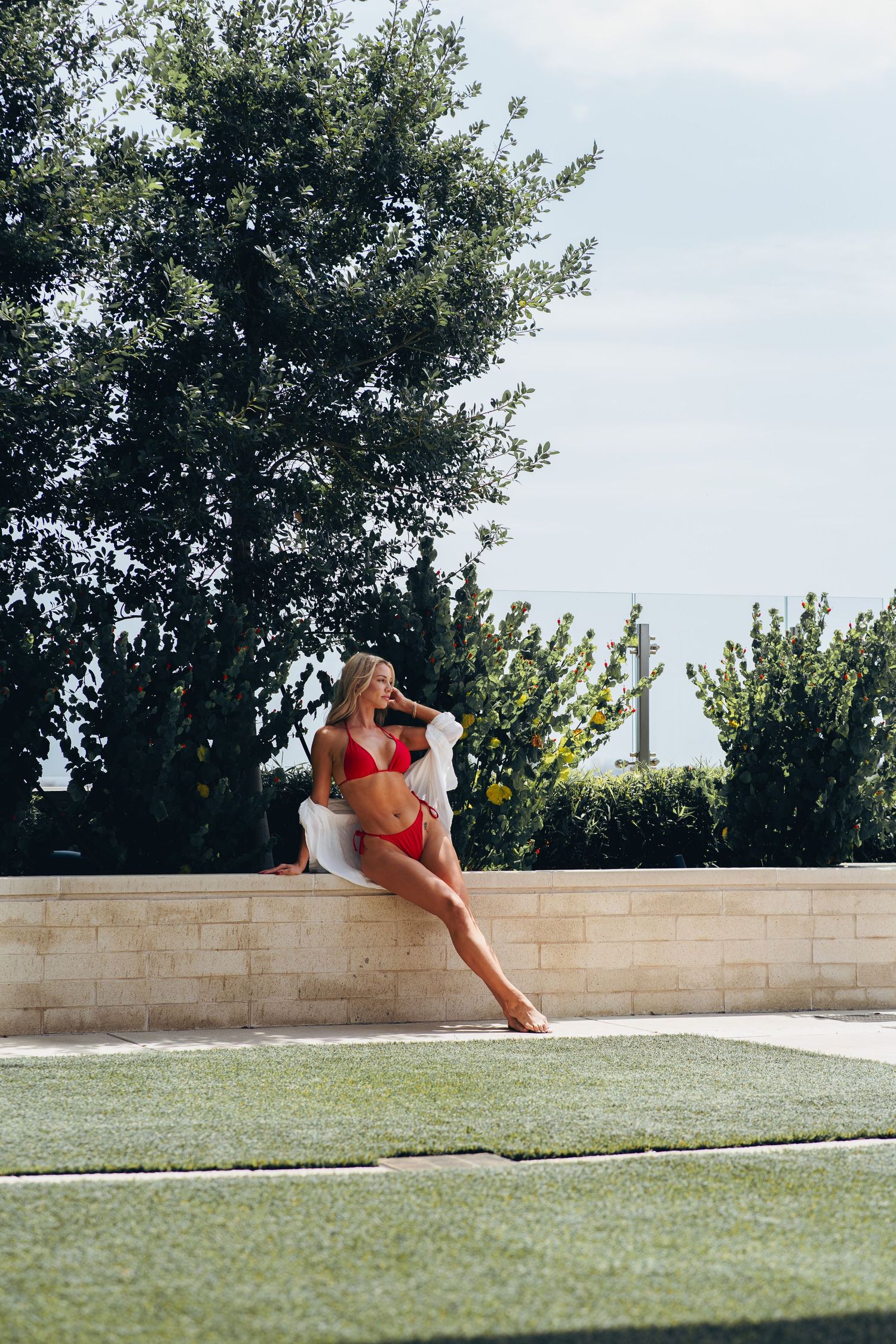
I actually love shooting around midday if the pool has trees creating patches of shade.
There's something about sunlight reflecting off the water while shadows break up the scene that creates a look I absolutely love.
Some of my favorite swimwear images have been shot in those conditions.
Everyone says avoid midday sun.
I'm saying...sometimes it looks incredible.
Styling Matters More Than People Think
A great location helps.
Good lighting helps.
But styling is often what ties everything together.
One of my favorite Summer Sessions took place at a beautiful older mansion with white pillars surrounding the pool.
The model wore a simple white one-piece swimsuit, oversized white hat, and heels.
Nothing about it felt overdone.
Everything just fit.
The wardrobe matched the location.
The location matched the mood.
The mood matched the images we wanted to create.
When everything works together, photography becomes a lot easier.
Skin Prep and Product Tricks I Always Use
Before almost every swimwear shoot, I run through a couple of small product tricks that make a noticeable difference in the final images.
Body Mist for Glow
I always use the sunless self-tanner body spray mist from Makai on the model before we start shooting. A light layer gives the skin a subtle glow and a little bit of shine that reads really well on camera, especially compared to flat, dry skin under studio flash or direct sun. It's a small step, but it consistently shows up in the final photos.
Glycerin for Shine and Wet Looks
I also keep glycerin on set. Mixed with a bit of water, it holds that "just got out of the pool" sweaty water-bead look on the skin, or it can be used to keep hair wet and slicked back for a more dramatic, editorial feel. It's an easy way to control the look without relying on the pool or ocean cooperating.
The Gear I Actually Bring
People always want to know what gear they need.
Honestly?
Less than you probably think.
For a lot of my favorite swimwear work, it was simply:
My Sony A7 III
A reflector
A solid model
A location I liked
An idea
That's it.
Could I have brought assistants?
Sure.
Hair and makeup?
Absolutely.
Wardrobe stylists?
They're incredibly valuable.
Big productions have their place.
But some of the strongest work I've ever created happened with almost nothing.
Sometimes less really is more.
Don't Be Afraid to Shoot Bad Photos
This might be the biggest piece of advice I can give.
Go fuck up.
Seriously.
Go shoot some bad work.
Everyone wants their first swimwear shoot to look like a campaign for a major brand.
It won't.
Mine didn't either.
The funny thing is, years later you'll probably look back at those old shoots and realize they weren't nearly as bad as you thought.
Your editing got better.
Your eye got better.
Your understanding of color improved.
Your standards changed.
The photos didn't necessarily get worse.
You just hadn't seen enough images yet to appreciate what you had created.
Experience changes how you evaluate your own work.
If You Want to Get Into Swimwear Photography
The first question I'd ask isn't what camera you own.
I'd ask why.
And I mean that honestly.
Photography is an incredible career, but I've seen too many people get into shooting models for the wrong reasons.
If you're just trying to be a fucking creep, kick rocks.
Models deserve to feel comfortable, respected, and safe on every set.
That includes how they're treated during the shoot and what happens with the images afterward.
If your intentions are genuine, here's what I'd recommend.
Reach out to modeling agencies.
Set up test shoots.
Find hair and makeup artists who want to collaborate.
Work with models who need portfolio content.
People test shoot all the time.
Show up prepared.
Know the vibe you're trying to create before the shoot starts.
Then go learn from as many people as possible.
Watch YouTube.
Take courses.
Hire photographers you admire for mentoring.
Ask questions.
I've done all of those things.
The best photographers steal ideas from everywhere, then eventually develop a style that's uniquely their own.
Take what works for you and leave the rest.
FAQ: Swimwear Photography
What camera settings work best for swimwear photography?
There's no universal setting that "fixes" swimwear photography. Understanding how light behaves in your specific environment — studio, beach, or poolside — matters far more than any specific aperture or shutter speed. Learn light first, then adjust settings to match the conditions in front of you.
Is midday sun bad for swimwear photos?
Not always. Most photography advice says to avoid it, but shooting a pool with trees creating patches of shade around midday can produce striking results — sunlight reflecting off the water combined with broken-up shadows. It depends on the location and how the light is interacting with it, not a blanket rule.
What's the best time of day to shoot swimwear at the beach?
A little before sunset through sunset tends to work well. It offers a mix of softer light while still keeping enough direction and contrast to make the swimwear pop — flattering and forgiving without losing energy.
Do you need expensive gear to shoot swimwear photography?
No. Some of the strongest swimwear work can come from a single camera body, a reflector, a solid model, a good location, and a clear idea. Bigger productions with assistants, hair and makeup, and wardrobe stylists have their place, but gear isn't what makes the shoot.
How do I get started shooting swimwear photography professionally?
Reach out to modeling agencies, set up test shoots, and connect with hair and makeup artists who want to collaborate. Show up prepared with a clear concept, then keep learning from other photographers through mentoring, courses, and simply shooting as much as possible.
What should I bring to a swimwear photoshoot?
At minimum: a camera you know well, a reflector, a location that fits the concept, and a clear idea of the vibe you're going for. Everything beyond that — assistants, styling, hair and makeup — is valuable but not required to create strong images.
Final Thoughts
If you've made it this far, you've probably noticed I didn't spend much time talking about camera settings.
That wasn't an accident.
Great swimwear photography isn't about owning the newest gear or memorizing the "perfect" settings.
It's about understanding light, planning with intention, creating a strong concept, working with good people, and shooting enough that you slowly develop your own eye.
I've learned just as much from the shoots that didn't go perfectly as I have from the ones that ended up in my portfolio.
Every photographer develops their own style over time.
This just happens to be what has worked for me.
If you're willing to keep learning, stay curious, and put in the reps, you'll eventually stop trying to shoot like everyone else and start creating work that actually feels like yours.
If you're a business looking to hire someone rather than become one yourself, contact us here.
"The best swimwear photos I've ever taken had nothing to do with what was in my camera bag. They came from understanding light, planning with intention, and being willing to shoot the bad ones on the way to the good ones."
PATT